





















Credit: Shutterstock
In 2026, humanoid robots moved out of research labs and onto factory floors.
For most of the last decade, people watched humanoid robots rather than working alongside them. Videos of robots doing backflips or dancing went viral, but very few of these machines had a real job. That has started to change.
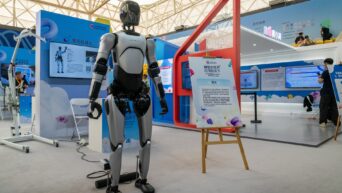
At this year’s IFA trade show in Berlin, 5 humanoid robots were on display with prices, specifications, and in some cases, active deployments. It was a clear sign that this technology is moving from research project to real product.
What Showed Up at IFA 2026
The robots shown at IFA covered a wide range of sizes, prices, and purposes. This shows that companies are no longer building one general robot for every task. They are building different robots for different jobs. Let’s take a look at those 5 robots:
- PrimeBOT Q1 is 88 centimeters tall and is built for research and home use. It has 22 degrees of freedom and is set to go on sale in China this month.
- Booster K1, made by a Beijing-based company, is 95 centimeters tall and costs around $5,999 to $10,000 depending on specifications. It runs on Python and ROS, which are common robotics software tools.
- EngineAI T800 is a larger, 173-centimeter robot built for heavy-duty work. It is already being used for police patrol duties in China.
- Agibot A3 demonstrated fine motor control by performing Chinese calligraphy, a task that requires precise hand movement.
- Zero W1 is a smaller robot focused on practical use. It can carry up to 20 kilograms and run for up to 25 hours on a single charge.
The Market Is Growing Fast
Investment in humanoid robotics has increased sharply this year. According to one industry analysis, venture funding into humanoid robotics companies reached about $8.7 billion through July 2026. That figure already exceeds total funding for all of 2025. Unitree, one of the most prominent companies in the space, has reached an IPO valuation of roughly $53 billion.
Shipment estimates vary between research firms, which is common in such a new market. Depending on the source, full-year 2026 shipment forecasts range from about 25,000 to 60,000 units worldwide. Even the lower end of that range represents a sharp increase from previous years. Longer-term forecasts are even bigger. Goldman Sachs recently raised its 2035 market size projection to $38 billion. These are estimates, not guarantees, but they point to more money and more robots entering the market each year.
Humanoid Robots Are Already on the Job
The more important shift may be where these robots are actually working, not just how many exist.
- Figure AI’s robots have logged more than 1,250 operating hours on a BMW production line connected to over 30,000 vehicles.
- Agility Robotics’ Digit robot has moved more than 100,000 totes at a GXO logistics facility.
- Mercedes-Benz has tested Apptronik’s Apollo robot in its operations.
- Hyundai plans to deploy Boston Dynamics’ electric Atlas robot on its production lines by 2028.
Production is also scaling. Figure has reportedly increased its manufacturing rate from one robot per day to one robot per hour in about four months. Agibot shipped its 10,000th unit earlier this year.
Who Is Actually Leading
Rankings based on commercial readiness currently place Figure AI at the top, followed by Agility Robotics, Unitree, AgiBot, and Boston Dynamics. These rankings are based on factors like current deployment hours, not just funding or press coverage.
Notably, Tesla’s Optimus, despite being one of the most publicly discussed humanoid robot programs, ranks 7th on this list. Elon Musk acknowledged in late 2025 that Optimus units currently working in Tesla’s own factories are mainly generating training data rather than performing productive labor. This suggests that public attention and actual commercial progress do not always move at the same pace.
The Challenges That Remain
Despite the growth, several problems remain unsolved.
Reliability and cost-effectiveness at scale remain largely unproven outside controlled pilot programs. The industry also lacks standardized ways to measure autonomous operating hours or failure rates, making it hard to compare companies’ claims directly.
In addition, Chinese manufacturers currently account for a large share of global shipment volume. New import restrictions in the United States could affect supply chains and pricing before the technology fully matures.
What This Means
Humanoid robots are no longer just a research topic or a marketing tool. Big companies are testing them in factories and warehouses, and some tests are producing measurable results. At the same time, long-term predictions, such as forecasts of hundreds of millions of humanoid robots in use by 2050, remain speculative and should be treated as possibilities rather than certainties.
The next few years will likely matter more than any single trade show demonstration. What will decide the winners in this industry is not which robot looks the most impressive on stage. It is which robot can perform the same task reliably, thousands of times, in a real workplace.