


























Credit: Shutterstock
NASA’s newest space telescope has successfully left Earth to hunt dark matter, dark energy, and new worlds.
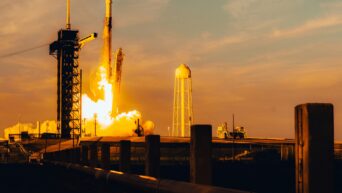
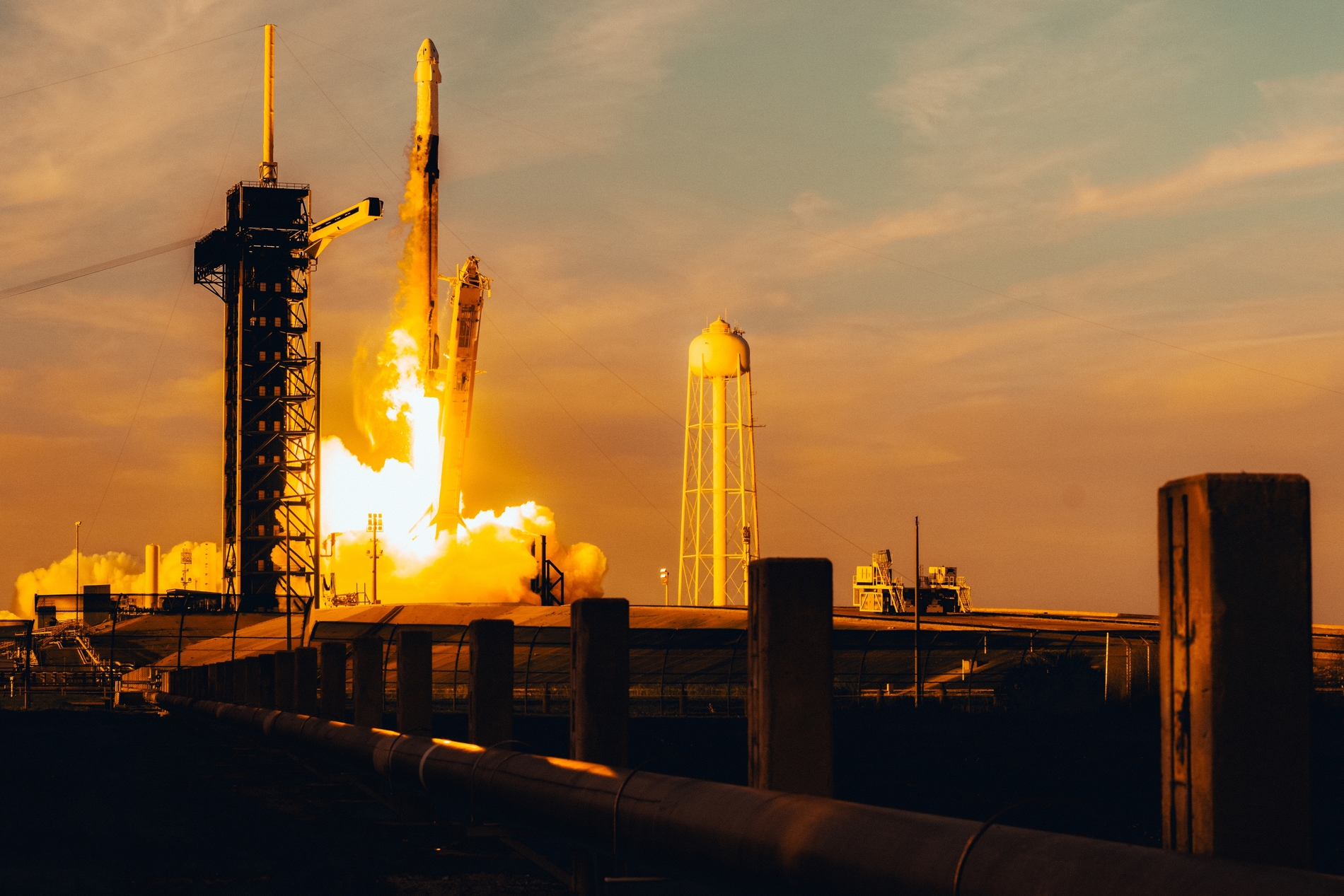
On Sunday, August 30, at 7:26 a.m. Eastern Time, NASA’s Nancy Grace Roman Space Telescope lifted off from Launch Complex 39A at Kennedy Space Center in Florida. It flew aboard a SpaceX Falcon Heavy rocket. The launch went smoothly, and the telescope separated from the rocket about 31 minutes after liftoff.
The mission has been in development for more than a decade. Earlier in its history, it faced several attempts to cut its funding, but Congress kept it alive each time. Now it is finally on its way to space.
A Telescope Built to See More
Roman is named after Nancy Grace Roman, NASA’s first chief of astronomy, who helped lay the groundwork for the Hubble Space Telescope decades ago. Roman is designed to build on Hubble’s legacy, but with one major advantage. It can capture a much larger part of the sky in a single image.
The telescope’s mirror is about the same size as Hubble’s, measuring 7.9 feet, or 2.4 meters, wide. However, Roman’s field of view is about 100x larger. This means it can produce images as sharp as Hubble’s, but across a far wider area of space at once.
Roman carries two main science instruments:
- Wide Field Instrument (WFI): A 300.8-megapixel infrared camera that will survey large regions of the sky and collect more than a terabyte of data every day.
- Coronagraph Instrument (CGI): A tool that blocks the glare of distant stars, letting scientists directly image planets orbiting them, including some nearly a billion times fainter than their host star.
Why Scientists Are Excited
Roman’s core mission is to study three of the biggest open questions in astronomy:
- Dark matter
- Dark energy
- Exoplanets
Dark energy is believed to make up about 68% of everything in the universe. Scientists do not yet know what it is, but they believe it drives the universe’s accelerating expansion. Roman will gather large amounts of new data to help researchers study this force in more detail.
NASA Administrator Jared Isaacman said the telescope’s surveys could reveal more than 100,000 new exoplanets, which would significantly expand the number of known worlds beyond our solar system.
However, Roman will not begin its science work right away. The telescope is now heading toward the second Sun-Earth Lagrange point, known as L2, located about 1 million miles from Earth. The trip will take roughly 3 months.
Once Roman reaches L2, it will settle into a stable orbit and go through a series of deployments, calibrations, and tests. If all goes as planned, the mission’s first science images are expected in early 2027.
Roman’s primary mission is set to run for 5 years, with a possible 5-year extension. NASA also built the telescope to be refuelable in the future, though no spacecraft currently has the ability to service an observatory at L2.
A Milestone for NASA and SpaceX
This was the 13th flight of a Falcon Heavy rocket and only the 3rd time the rocket has carried a major NASA science mission, following the Psyche and Europa Clipper launches. Both of the rocket’s side boosters landed safely back at Cape Canaveral Space Force Station shortly after liftoff.
NASA officials described the mission as a rare example of a major space project delivered ahead of schedule and on budget. Isaacman said the achievement reflects more than ten years of work from NASA’s team and its industry partners.
With Roman now on its way to deep space, astronomers are preparing for what could become one of the most detailed surveys of the universe ever attempted.