



























Credit: Shutterstock
The world’s richest companies want to move AI off the Planet. SpaceX is betting its whole stock market launch on it. And the tech giants cannot agree on whether it will work.
Artificial intelligence needs an enormous amount of power. AI data centers consume large amounts of electricity, water for cooling, and land. As demand for AI continues to grow, these centers are straining power grids and disrupting the communities built near them.
So tech companies thought to put the data centers in space instead.
In orbit, you get free, constant solar power and the cold vacuum of space to help dump excess heat.
What Is an Orbital Data Center?
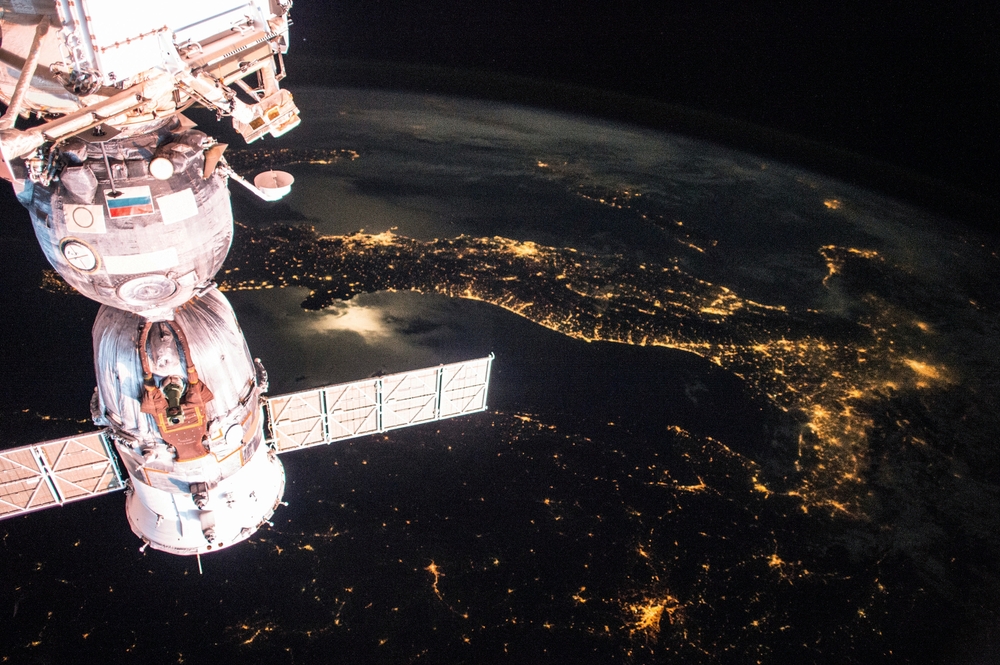
An orbital data center is a satellite, or a network of satellites, that hosts the same kind of computer servers used in a data center on Earth. Instead of sitting in a warehouse, the computers float in orbit, powered by solar energy, processing data and beaming the results back down to the ground.
It is a simple idea on paper. The hard part is making it actually work.
The Big Players
The race has attracted some of the most powerful companies and people in tech.
1. SpaceX.
Elon Musk’s company is the loudest voice. In January 2026, it filed plans with US regulators to launch up to 1 million data-center satellites. Musk has claimed that within two to three years, the cheapest place to run AI computing will be in space.
2. Google.
The search giant is running a project called Suncatcher. It plans to launch two prototype satellites in early 2027, built with the satellite company Planet, to test how AI runs in orbit. Google is also in talks with SpaceX to use its rockets for launches.
3. Blue Origin.
Jeff Bezos’s space company filed plans for a project called Sunrise, aiming to launch over 51,000 data-center satellites into low Earth orbit, with deployment expected to begin in late 2027.
4. NVIDIA.
The chipmaker behind most of the world’s AI hardware launched a Space Computing program, putting its powerful chips into orbital systems. Several startups already use NVIDIA’s platforms for space missions.
5. Cowboy Space.
A startup, formerly named Aetherflux and founded by a Robinhood co-founder, raised 275 million dollars this month to build both the rockets and the satellites needed for orbital computing.
6. Starcloud.
This company already deployed an advanced NVIDIA computing system in orbit and became the first to train an AI language model in space.
The Most Recent Developments
The whole topic exploded into the headlines this week after SpaceX filed paperwork to go public, potentially making it the largest stock listing in history. The company is seeking a valuation of up to 1.75 trillion dollars and hopes to raise as much as 50 billion dollars, with much of that funding earmarked for building data centers in space.
The filing also revealed SpaceX’s finances for the first time in its 24-year history. In 2025, the company brought in around 18.67 billion dollars in revenue but posted a net loss of 4.94 billion dollars. Its AI division burned through $6.4 billion while bringing in only $3.2 billion. One of the most notable details was that Anthropic, a direct rival to Musk’s AI company, is paying SpaceX $ 1.25 billion to use its computing power.
In short, SpaceX is asking investors to fund a future built largely on a technology that does not yet fully exist.
The Reality Check
Not everyone is convinced this is happening soon.
Jeff Bezos, who is building his own space data centers, said this week that the 2- to 3-year timelines being thrown around are “probably a little ambitious.” He pointed out that chip costs need to decrease, launch costs need to drop further, and the energy demands remain enormous.
The engineering problems are real. The solar panels needed to power a large data center in space would be bigger than anything ever assembled in orbit. Cooling is harder than it sounds, because heat does not spread easily in the vacuum of space and must be radiated away slowly. And launching tens of thousands of new satellites increases the risk of orbital crowding and collisions.
There is also a rocket shortage. There aren’t enough launch vehicles to carry all these satellites, and the ones that exist are expensive. Many companies are pinning their hopes on SpaceX’s giant Starship rocket to lower costs. Starship completed its 12th test flight on May 22, 2026, the first flight of its newest version, with a controlled splashdown in the Indian Ocean despite losing one engine during the climb. It works, but it is still in testing and likely years away from routine commercial use.
One analyst this week summed up the doubt by calling the orbital data center vision a “1.75 trillion dollar bridge to nowhere.”
So, What Is the Future?
Nobody knows for certain yet.
The vision is big, and the money behind it is enormous. Some computing tasks, such as processing satellite images directly in orbit, could move into space fairly soon. But the dream of giant data centers replacing the ones on Earth is still years away, and it depends on cheaper rockets, better cooling, and falling chip costs all coming together at once.
What is clear is that the smartest and richest people in tech are taking the idea seriously enough to bet billions on it. Whether it becomes the foundation of the AI era or an expensive lesson in the limits of physics is the real 1.75-trillion-dollar question.