















Credit: Shutterstock
Adidas hid a tiny smart chip inside every FIFA World Cup 2026 ball.
Before the referee blows the whistle at any FIFA World Cup 2026 match, they take the football and place it on a wireless charging cradle. And that one detail tells you everything about how far football technology has come.
Meet the Trionda
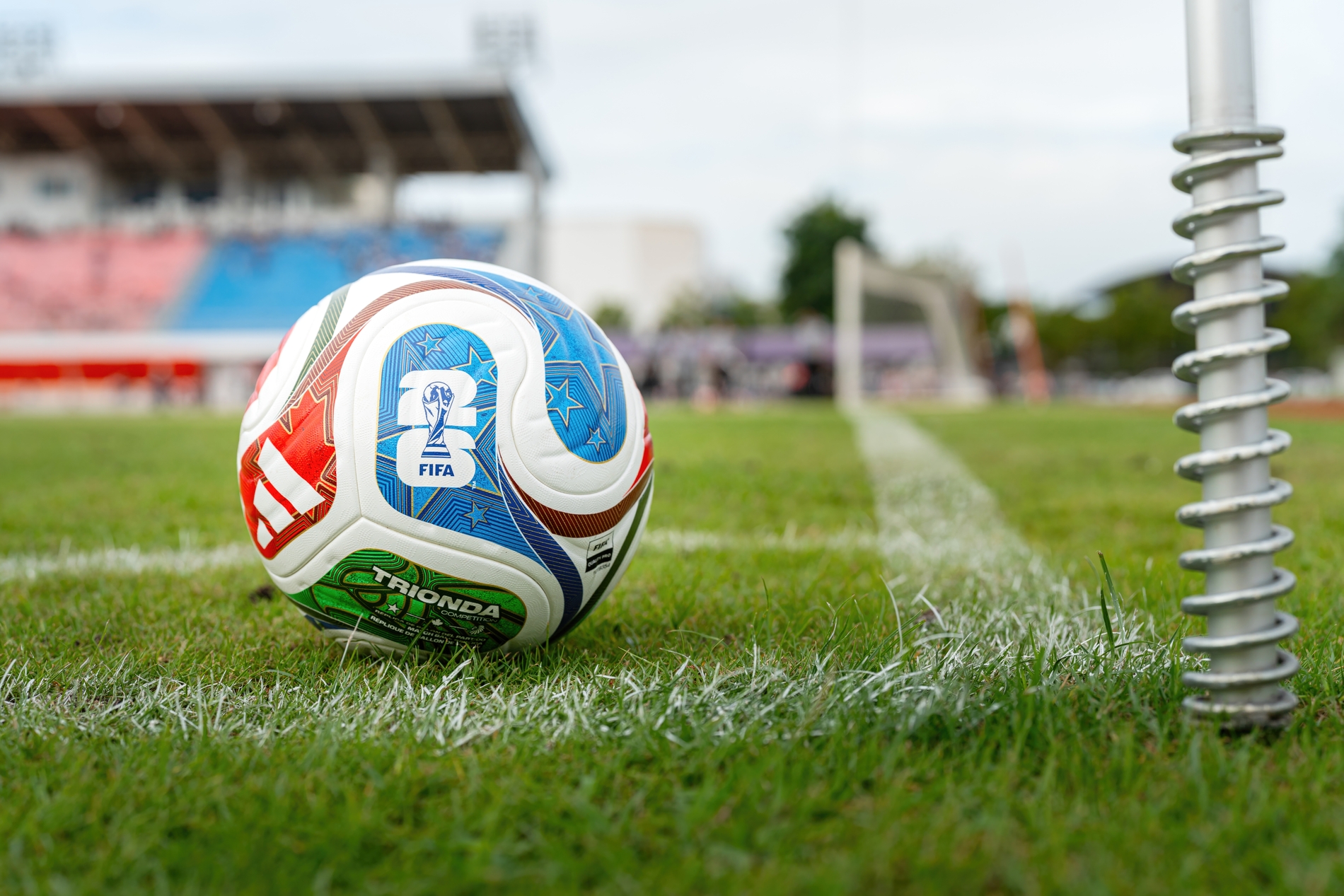
The official match ball of the FIFA World Cup 2026 is called the Trionda, made by Adidas. The name comes from the Spanish words Tri (three) and Onda (wave), a tribute to the three co-host nations: Canada, Mexico, and the United States.
The design also reflects this beautifully: red, green, and blue panels carry the USA star, the Canadian maple leaf, and the Mexican eagle as embossed textures, all meeting at a triangular pattern at the center.
But the design, as gorgeous as it is, is the least interesting thing about this ball.
What Adidas hid inside it is the real story.
Tucked inside one of the Trionda’s four panels is a tiny Inertial Measurement Unit (IMU) motion sensor chip, weighing just 14 grams. It is part of Adidas’ Connected Ball Technology, and it does something no football in history has ever done this well.
It captures 500 data points every single second.
Five hundred times per second, this chip records the ball’s acceleration, spin, rotation, and every contact event. Every touch, deflection, pass, shot, and flick. All of it is logged, timestamped, and transmitted wirelessly to the VAR room in real time, where it is fed into FIFA’s semi-automated offside system alongside optical tracking cameras spread across the stadium.
The result is a continuous, live digital model of the match, built around the ball itself.
Why the Chip Is Inside a Panel, Not the Center
At the 2022 World Cup in Qatar, Adidas introduced the Al Rihla, the first World Cup ball with a connected chip. That sensor sat at the very center of the ball, suspended in place by a special mounting system. It worked. But for the Trionda, Adidas moved the chip to the side.
It now sits within a specially created layer inside one of the four panels. And to make sure the ball still flies perfectly, the other three panels carry precision counterweights. This keeps the ball balanced and ensures it behaves exactly as a football should in flight.
Why the change?
The panel-mounted approach allowed for a cleaner four-panel construction, reportedly the fewest panels ever used on an official World Cup ball. Fewer panels mean fewer seams, and fewer seams mean more predictable flight paths.
How the Chip Helps on the Pitch
Let us talk about what this chip does in practice, because it is not just a technical novelty.
Offside decisions have long been football’s most frustrating flashpoint. The old VAR process involved freezing video frames and drawing lines manually, which led to delays and marginal calls that hinged on a player’s armpit. The Trionda’s chip eliminates that ambiguity at the source. Because the sensor captures the precise millisecond at which the ball is struck, officials know exactly when the pass was played. That is then combined with player positional tracking from stadium cameras to determine whether any attacker was offside with a degree of accuracy measured in centimeters.
Handball decisions also benefit. The ball’s motion signature changes when it contacts a hand or arm differently than when it contacts a boot or head. The chip can confirm not just whether contact happened, but exactly when, giving referees a data point that no camera angle alone can provide.
Goal-line situations get an additional confirmation layer on top of existing optical systems, reducing any remaining doubt.
For fans watching at home, all of this translates into cleaner, faster, more transparent decisions.
The Battery: 90 Minutes to Charge, 6 Hours to Last
Back to the charging. Here is how it works.
The Trionda’s sensor runs on a small internal battery. Before every match, the ball is placed on a wireless charging cradle. It takes around 90 minutes for a full charge. Once charged, the sensor is operational for nearly 6 hours.
When the ball goes out of play and sits on the sideline, the sensor intelligently detects that it is off the pitch and shifts into hibernation mode to conserve battery.
An Adidas spokesperson confirmed that the battery cannot be bypassed: the sensor will not operate without it. Each match-day venue has multiple balls prepared on charging cradles to ensure there is always a ready replacement if needed mid-match.
Made in Sialkot, Pakistan
The Trionda is manufactured by Forward Sports, based in Sialkot, Pakistan. Sialkot has been producing a significant portion of the world’s footballs for decades, and Forward Sports also made the Al Rihla in 2022. The fact that a ball stuffed with wireless sensors, precision IMU chips, and counterweighted panel systems is still being crafted in one of football manufacturing’s great cities is a satisfying piece of continuity.
The Big Question: Can You Buy It
If you want a Trionda of your own, Adidas has made the Trionda Pro available for purchase at around $170. Just know that the retail version does not include the connected sensor system.