



























Credit: Unsplash
AI deep learning algorithms crack the secrets of the universe’s heaviest elements
Scientists have built an AI model that, for the first time, simulates how the universe’s heaviest elements form inside colliding neutron stars, and it does so without burning impossible amounts of computing power.
Gold does not come from the earth. Neither does uranium, platinum, or most of the elements heavier than iron on the periodic table. According to physicists, these metals were forged in some of the universe’s most violent events, such as neutron star mergers and supernova explosions. Even though we know a lot about these cosmic events, accurately simulating them is still one of astrophysics’ toughest challenges. But a new artificial intelligence model developed at Germany’s GSI/FAIR research facility may have just changed that.
The model is called RHINE (r-process heating implementation in hydrodynamic simulations with neural networks). Published in Physical Review D, RHINE applies machine learning, specifically a deep learning neural network, to represent the energy released by nuclear reactions during the r-process within hydrodynamic simulations. It is the first time this approach has been used, and the results are significant.
What Is the R-Process?
To understand why RHINE matters, it helps to grasp the process it models. Many rare elements are produced in powerful astrophysical events, such as supernova explosions and neutron star mergers. These events generate enormous amounts of energy and free neutrons, enabling the rapid neutron-capture process, or r-process, which is responsible for producing gold, uranium, and many more elements.
Although the r-process happens in just seconds during a cosmic event, simulating it on a computer is far more difficult. Scientists have to track thousands of different isotopes, calculate how much energy each one releases, and then determine how that energy affects the movement and explosion of surrounding matter. This cycle, called r-process heating, is so computationally intensive that many past simulations either left it out or relied on simplified approximations.
How RHINE Works
RHINE sidesteps this bottleneck with a two-step machine learning strategy. First, the ML models are trained using a large number of reference calculations produced with a full set of nuclear reactions. In other words, RHINE learns what the answer should look like from pre-run calculations, and then applies that learned knowledge to live simulations at a fraction of the computational cost.
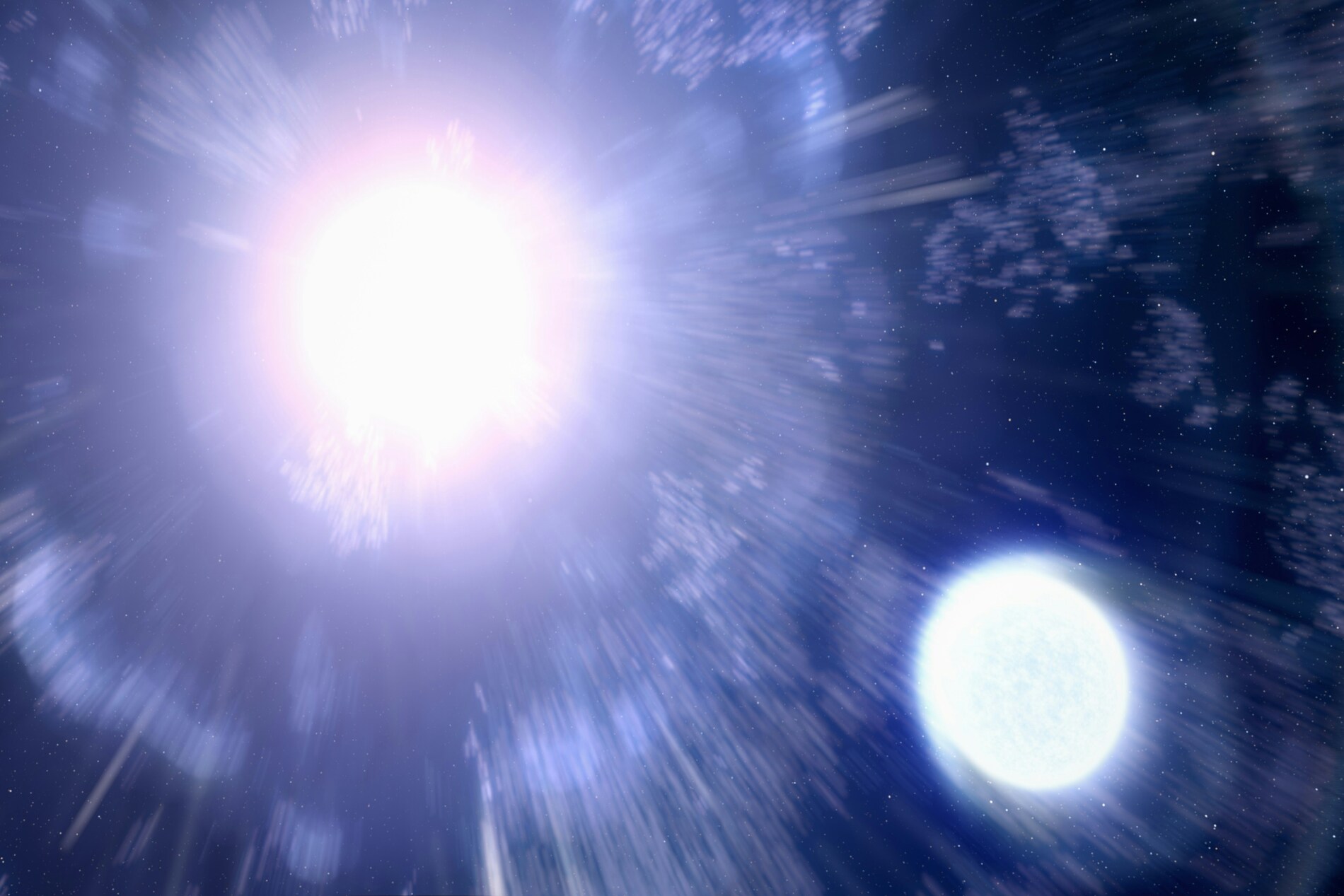
This is important because the heat produced during the r-process is not merely a byproduct. It affects how fast the ejected matter travels, how it spreads through space, and how bright the explosion appears. After two neutron stars collide, the expanding debris creates a bright burst of light known as a kilonova. By modeling r-process heating more accurately, RHINE can better predict how a kilonova will evolve and what astronomers should expect to observe.
Why It Is a Big Deal
Hydrodynamic models of neutron star mergers often neglect r-process heating entirely or include it using crude parametrizations, due to the complexity of detailed nuclear networks required to describe the r-process self-consistently. RHINE offers a way to do this properly without making the simulations prohibitively slow.
Dr. Oliver, the first author of the study and a researcher in the Nuclear Astrophysics and Structure department at GSI/FAIR, explains, “Researchers around the world strive to make these complex reactions understandable through theoretical simulations. However, modeling all parameters requires immense computational power, which is why models often have to be simplified. Our new model RHINE, which uses artificial intelligence, offers an efficient alternative.”
Dr. Zewei Xiong, who played a central role in designing RHINE’s machine learning algorithm, added that the team carefully validated its approach. The high level of agreement between RHINE’s outputs and the full reference calculations suggests the model is not cutting corners on accuracy. It is simply cutting corners on time.
What Comes Next
The researchers say RHINE could enable more detailed simulations in the future, helping connect results from experiments at the upcoming FAIR facility with astronomical observations of stellar explosions and neutron star mergers.
FAIR, the Facility for Antiproton and Ion Research, currently under construction adjacent to GSI, is expected to generate vast amounts of new nuclear data. RHINE could serve as the bridge between those laboratory measurements and what telescopes observe when neutron stars collide.
Critically, the team has made RHINE’s source code publicly available, allowing research groups around the world to begin using and building on it immediately. In a field where simulations can take months to run on the world’s most powerful computers, a tool that delivers comparable accuracy in a fraction of the time is exactly the kind of practical advance that moves science forward quickly.
The gold in your jewelry came from a dying star. It now takes an AI to understand how.