




























Credit: Shutterstock
Asian AI startups have spent the past 17 days filling the vacuum left by Anthropic’s export ban.
On June 9, 2026, Anthropic released Claude Fable 5 and Mythos 5 to the public. These models were notable for their performance on automated vulnerability finding.
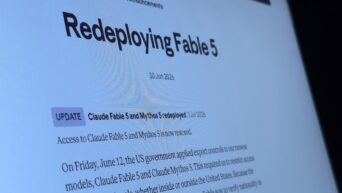
Three days after launch, on June 12, 2026, the US Department of Commerce issued an export control directive ordering Anthropic to suspend all access to Fable 5 and Mythos 5 by any foreign national, whether inside or outside the United States.
Because Anthropic’s infrastructure cannot filter users by nationality, the company disabled both models globally for every user to ensure compliance. It has been 17 days since the ban began, and it remains in effect. However, talks between Anthropic and government officials are still ongoing.
Asia’s Response: Two Products, Two Strategies
1. Sakana AI Fugu
Tokyo-based Sakana AI launched Fugu on June 22, 2026, ten days into Anthropic’s export ban. The company was founded in 2023 by Llion Jones, a co-author of the original “Attention Is All You Need” transformer paper, and David Ha, a former Google DeepMind research director.
Fugu is not a single large language model. It is a multi-agent orchestration system that assigns tasks across a pool of external frontier LLMs, delegating to different models based on the task type, then consolidating outputs into a single response.
Sakana has introduced two versions: Fugu for everyday, latency-sensitive tasks, and Fugu Ultra for complex, multi-step reasoning and long-horizon agentic workflows.
On SWE-Bench Pro, Fugu Ultra achieved a 73.7% score, outperforming Claude Opus 4.8 (69.2%), GPT-5.5 (58.6%), and Gemini 3.1 Pro (54.2%). It also topped Sakana’s AutoResearch benchmark with the highest mean bits-per-byte score.
Critically, neither Fable 5 nor Mythos Preview is part of Fugu’s agent pool because both are inaccessible due to export controls. Sakana’s website now markets the product as “delivering frontier capability without the risk of export controls.”
2. 360 Security Tulongfeng
Two days later, Chinese cybersecurity firm 360 Security Technology unveiled two AI tools at the ISC.AI 2026 conference in Beijing. Founder Zhou Hongyi presented both tools under the collective name “Yitian Tulong,” drawn from the classic Chinese martial arts novel “The Heaven Sword and Dragon Saber.”
The first model, Tulongfeng, is designed to automate software vulnerability discovery, while the second model, Yitianzhen, focuses on cyber defense and incident response.
Zhou described Tulongfeng as “China’s version of Mythos,” presenting it as a strategic response to the growing AI gap. According to the company, the model has identified 3,432 software vulnerabilities, including 105 confirmed by Chinese government authorities. Zhou also acknowledged that Chinese AI models are still 20–30% behind their US counterparts in core capabilities, but argued that waiting to achieve parity before deployment was not a practical strategy.
He further warned of what he called “one-way transparency,” a scenario in which US organizations equipped with Mythos-level AI can identify vulnerabilities in software systems while other countries lack comparable capabilities.
Where the Ban Stands Today: June 29, 2026 (Day 17)
Fable 5 remains offline for all.
On June 26, Commerce Secretary Lutnick sent a revised letter to Anthropic that partially lifted restrictions on Mythos 5, but not Fable 5.
On June 27, Anthropic posted an official update confirming the partial Mythos 5 restoration for Annex A institutions and stated it was “continuing to work with the government to expand access to Mythos 5 and make Fable 5 available for general use again.”
Wrapping Up
The precedent set on June 12 is the most consequential part of this story. The US government demonstrated that it can take a commercially deployed, globally used frontier AI model offline within minutes. Enterprises outside the US now know that access to American frontier AI can be cut at any time, for any declared security reason, with no advance notice and no minimum due process. That is the single most powerful marketing argument Sakana AI and 360 Security have, and they did not have to make it themselves.