






















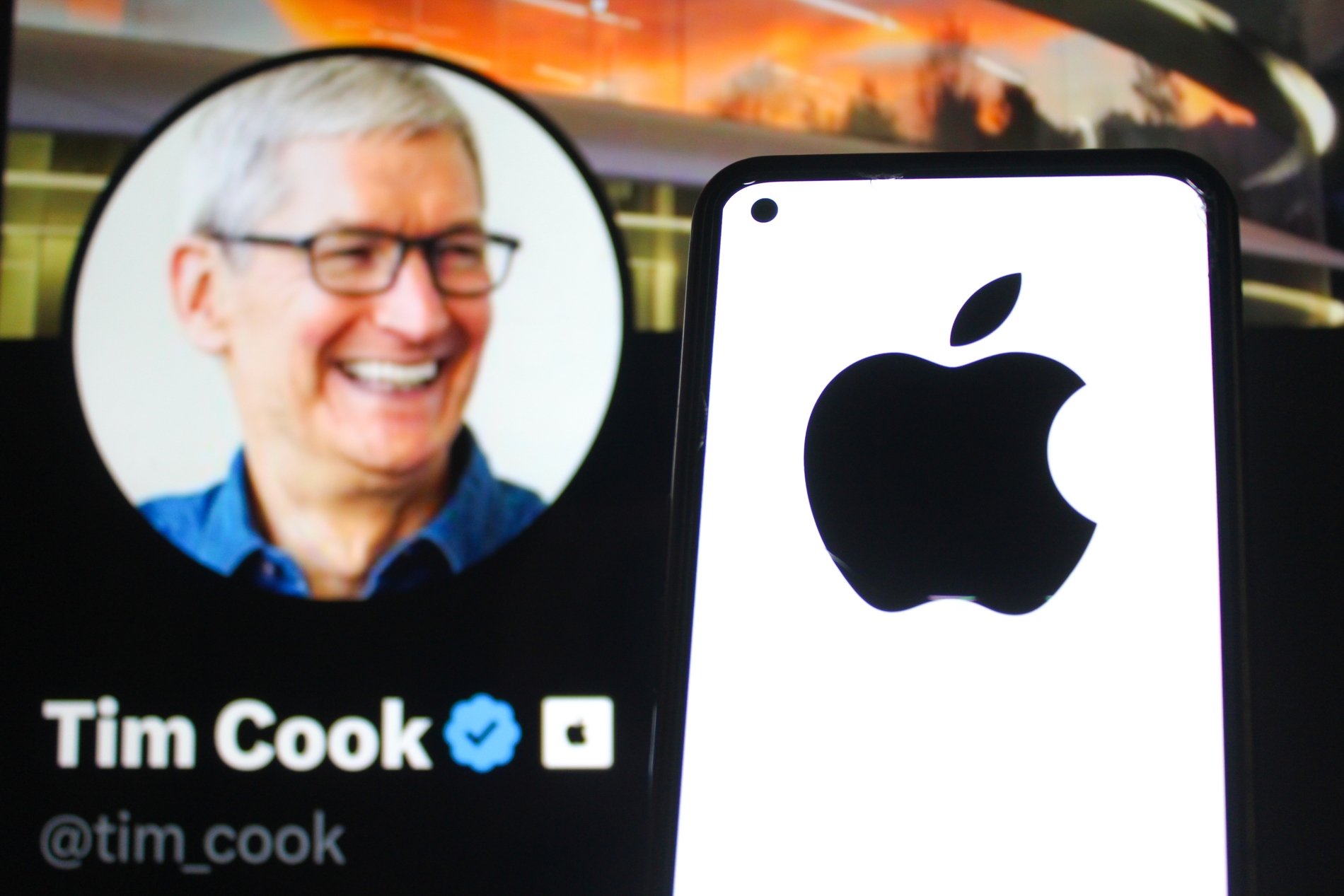
Credit: Shutterstock
After 15 years, Tim Cook is out. And the man walking into his office has a mountain of problems waiting on the desk.
It’s official. Apple announced on Monday that Tim Cook is stepping down as CEO, handing the reins to John Ternus, the company’s senior vice president of hardware engineering. The transition takes effect on September 1. Cook isn’t disappearing entirely. He’ll move into the role of executive chairman.
But here’s the kicker. Just last month, Cook sat down with ABC’s Good Morning America and denied he was going anywhere. “Twenty-eight years ago, I walked into Apple, and I’ve loved every day of it since,” he told viewers, brushing off retirement talk as nothing more than rumor.
Ternus will become the third person to lead Apple in its 50-year history, following Steve Jobs and Cook himself.
Who Is John Ternus?
The new Apple CEO: John Ternus!
He will take over as CEO on September 1, 2026 pic.twitter.com/wlMVb83o9l
— Apple Hub (@theapplehub) April 20, 2026
Ternus has spent the last 25 years at Apple building some of its most beloved products, all while staying almost completely out of the spotlight.
He’s 51, and he joined Apple back in 2001, right out of college. His very first project was counting the grooves on screws for the Apple Cinema Display at a supplier facility past midnight. He has told that story himself, laughing about how he stood there with a magnifying glass, arguing with a supplier over whether a screw had 25 or 35 grooves.
That obsession with detail never left him.
By 2013, he was VP of hardware engineering. By 2021, he was SVP. He’s had a hand in building the iPad, AirPods, Apple Watch, Apple Silicon chips, Vision Pro, and, most recently, the MacBook Neo.
More recently, he’s been stepping into the spotlight, accompanying executives on international tours, meeting with employees at far-flung offices, and serving as a key face of the company during the iPhone 17 launch.
Tim Cook put it when he said Ternus has “the mind of an engineer, the soul of an innovator, and the heart to lead with integrity.” But now Ternus has to deliver on that.
What Tim Cook Is Leaving Behind
Let’s give credit where it’s due. Cook’s tenure at Apple was remarkable by almost any measure.
OpenAI CEO Sam Altman posted on X.
Tim Cook is a legend.
I am very thankful for everything he has done and I am very thankful for Apple.
— Sam Altman (@sama) April 20, 2026
When he took over in 2011, Apple was a company many people genuinely believed could not survive without Steve Jobs. He proved them wrong. Under his watch, Apple’s revenue more than quadrupled, climbing to over $400 billion annually. Apple’s market capitalization reached $4 trillion by the time of the announcement, a roughly 24-fold increase under Cook’s leadership.
He also built Apple Services into a business doing over $100 billion a year. The Apple Watch alone accounts for roughly 25% of global smartwatch sales. AirPods are everywhere, too. These were Cook’s bets, and they paid off.
He managed the company during the COVID-19 pandemic. He managed trade tensions with China. He charmed and clashed with two Trump administrations. Earlier this year, he pledged $600 billion in US investment and personally gifted Trump a glass plaque from an Apple supplier. The man knew how to play the long game.
But for all of that, Cook is leaving Ternus with one very messy, very expensive, very public problem.
The AI Problem Nobody Can Ignore
Apple has been losing the AI race, and everyone knows it.
While Microsoft, Google, Amazon, and Meta have collectively invested hundreds of billions of dollars in building AI infrastructure, Apple has been watching from the sidelines. The company has no serious foundational AI model of its own.
Then came the Siri disaster. Apple promised a major Siri upgrade that would finally make it competitive with ChatGPT and Google’s Gemini. Then they delayed it. Then they replaced their AI chief with a Google veteran. Now they’re reportedly rebuilding Siri on top of Google’s Gemini model, which is either a smart partnership or an admission of defeat, depending on who you ask.
Meanwhile, over on the App Store, ChatGPT and Anthropic’s Claude are currently the two most downloaded free iOS apps. Gemini sits at number four, and Meta AI at eight. People are using iPhones to access AI that Apple doesn’t build.
Why a Hardware Guy Makes Sense Here
Why Apple chose a hardware engineer to lead the company into an AI-driven future is actually a reasonable bet.
Apple has long believed that the future of AI isn’t just in the cloud — it’s on the device. They’ve been building AI-capable chips into iPhones since 2017. The idea is that within a few years, powerful AI workloads will run directly on your phone, which plays right into Apple’s biggest strength: tightly integrated hardware and software.
Forrester principal analyst Dipanjan Chatterjee put it well, saying that Ternus, being a hardware engineer, signals that Apple will seek differentiation in its physical products, even as it looks to reframe the device as a substrate for intelligent experiences.
Apple is also reportedly developing AI-powered wearables, including smart glasses, a pendant, and AirPods with cameras. A foldable iPhone is expected in September. These are hardware-first AI products, and that’s exactly Ternus’s wheelhouse.
The Road Ahead Is Not Easy
Ternus is walking into a position facing real headwinds.
Geopolitical tensions and tariffs are complicating the supply chain. Memory prices are soaring due to global demand for AI chips. The Vision Pro headset has struggled badly with consumers. Its sales have fallen short of 1 million units since its February 2024 launch, despite it being a product Cook once called Apple’s next great platform.
Apple shares dipped about 0.5% in after-hours trading following the announcement, which signals that investors aren’t throwing a party just yet.
The clock is also ticking on a near-term test. Apple’s second-quarter earnings report drops on April 30, and all eyes will be on Ternus as investors start directing their questions toward the man who will soon be running the show.
Apple’s Worldwide Developers Conference in June will be another early test. That’s where the company is expected to finally unveil the revamped Siri. If it impresses, Ternus gets off to a strong start. If it falls flat again, the questions will get louder fast.
Bottom Line
John Ternus now has to build the strategy that will Apple’s future.
In his statement, Ternus said he is “profoundly grateful” for the opportunity and “filled with optimism” about what Apple can achieve. That’s the right thing to say. But optimism alone won’t close the AI gap.
Tim Cook turned Apple into a $4 trillion machine. That’s an extraordinary legacy. But the next chapter won’t be about supply chains and wearables. It will be about whether Apple can finally show the world it has a real answer to ChatGPT, Gemini, and everything else coming down the line.
The answer now belongs to John Ternus, and the clock starts on September 1.