



























Credit: Shutterstock
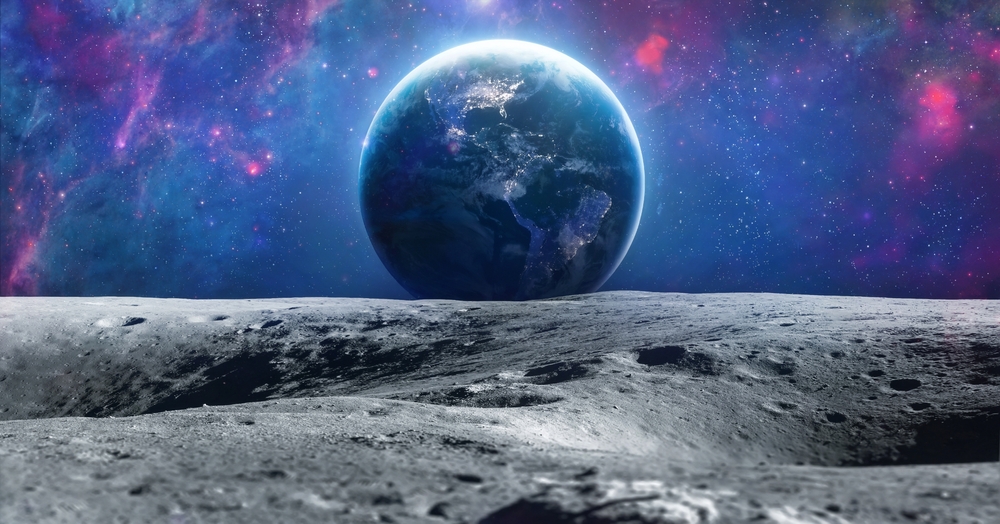
For more than 4.5 billion years, the Moon has been Earth’s loyal companion, lighting up our nights, guiding our tides, and even inspiring myths and love songs. But here’s a surprising twist in our cosmic friendship: the Moon is slowly drifting away from us.
According to Dr. Stephen DiKerby, a physicist at Michigan State University, the Moon is inching farther from Earth at a rate of about 1.5 inches (3.8 cm) every year. That may sound tiny, but over millions of years, this subtle shift adds up.
And here’s where it gets interesting: as the Moon moves away, Earth’s spin slows down. In practical terms, that means our days are gradually getting longer. Around 70 million years ago—when dinosaurs still roamed—Earth’s days were just 23.5 hours long. Fast forward to the distant future, and our days could eventually stretch to 25 hours.
So, should we start planning for an extra hour of sleep? Not quite. The changes are incredibly slow. Dr. DiKerby reassures that we won’t notice anything in our lifetimes—or even in the lifetimes of countless generations ahead. Right now, the difference is so small that we’ll keep enjoying 24-hour days, ocean tides, and eclipses for millions of years to come.
Why is the Moon Drifting Away?
It all comes down to tides. The Moon’s gravity pulls on Earth’s oceans, creating bulges of water. Because Earth rotates faster than the Moon orbits, these bulges get tugged slightly ahead. That forward pull gives the Moon a little boost, nudging it into a higher orbit. In simple terms, our tides are slowly pushing the Moon farther out into space.
What Happens in the Far Future?
If we could fast-forward billions of years, Earth’s rotation might eventually slow so much that one side of our planet always faces the Moon—just as the same side of the Moon always faces us now. But long before that happens, our Sun will change everything. In about a billion years, it will grow brighter and boil away our oceans. A few billion years after that, it will swell into a red giant, likely swallowing Earth and the Moon together.
So while our celestial companion is drifting away, this is more of a poetic thought experiment than a pressing concern.
A Quick Word on Gravity
Gravity is the invisible glue that keeps all of this in motion. It’s the weakest of the four fundamental forces in physics, yet its reach is infinite. On Earth, gravity pulls at 9.8 m/s², strong enough to keep us grounded. On the Moon, it’s just 1.6 m/s², which is why astronauts bounced around so lightly. On Jupiter, however, gravity is a crushing 24.8 m/s²—enough to make you weigh over twice as much as you do here on Earth.
The Bottom Line
The Moon may be drifting away, but don’t worry—it’s not abandoning us anytime soon. The changes are happening on timescales so vast, they make human history look like the blink of an eye. For now, we can simply look up, enjoy the Moon’s glow, and marvel at the slow, graceful dance of the cosmos.